

Walk into your next evaluation with evidence, not a hunch.
Most evaluations end on a rule, not a bad idea: a trailing drawdown, a daily limit, a consistency cap. AlgoLift lets you build a systematic strategy without code and see how it fares under your account's exact rules before you pay for the attempt.
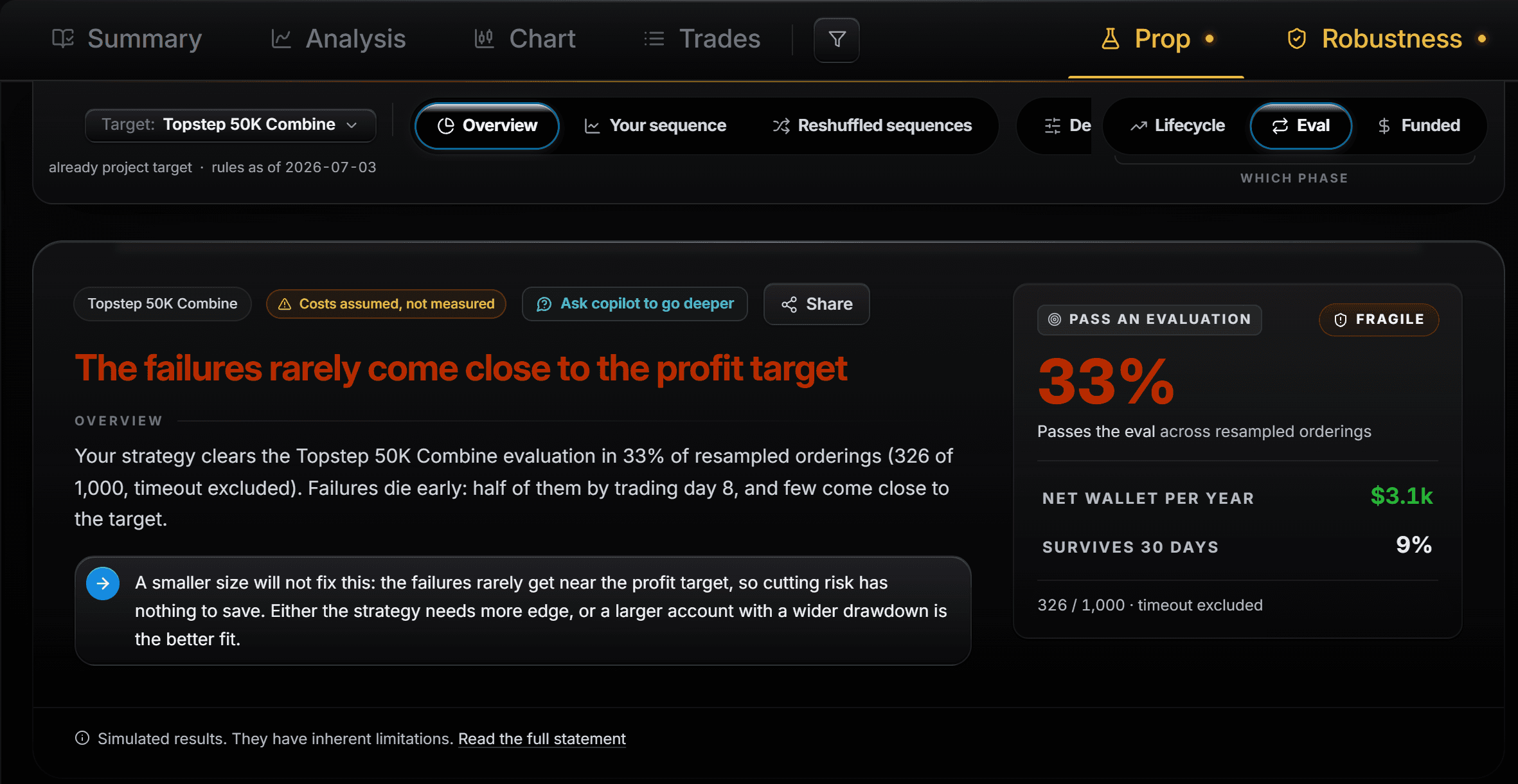
Simulated results. They have inherent limitations. Read the full statementHide the statement
These results are based on simulated or hypothetical performance results that have certain inherent limitations. Unlike the results shown in an actual performance record, these results do not represent actual trading. Also, because these trades have not actually been executed, these results may have under-or over-compensated for the impact, if any, of certain market factors, such as lack of liquidity. Simulated or hypothetical trading programs in general are also subject to the fact that they are designed with the benefit of hindsight. No representation is being made that any account will or is likely to achieve profits or losses similar to these being shown.
From an idea to a funded account, in order.
Five steps, each one a question an evaluation will ask of your strategy whether you ask it first or not.
- 01
Describe the strategy you trade, or the one you want to.
Algo builds it from plain English and shows every rule in words, so a discretionary habit becomes a strategy you can test.
The copilot - 02
Test it on years of real ticks.
Start with the latest month on the Home chart, 5 times a day at no charge, then run years of history in a project.
Backtesting - 03
Apply the account you are about to buy.
The pass rate across thousands of reorderings of your trades, the rule that ends the account most often, and what passing is likely to cost in fees and resets.
The prop simulator - 04
Find out whether it was luck.
Robustness rebuilds the run from its own trades, the Luck Test compares your entries with random timing, and Optimize counts every setting you try.
Robustness - 05
Test it on months it has never seen.
The project's sealed holdout, tested once, then a forward stream scored on each new day of data.
Forward testing
Will I pass the eval?
Pass an evaluation
You're not funded yet. Optimize your strategy for the highest chance of passing.
How much can I actually pull out?
Maximize withdrawals
You're already funded. Pull out as much as you can without losing the account.
What does the whole grind net me?
Full prop lifecycle
One strategy, every stage: eval, funded, payouts, resets. What a year of it nets.
Is this edge real?
Standard strategy
No prop firm. Build it, validate it, prove the edge is real.
Read the rules before you pick the account.
Every firm and plan AlgoLift simulates, compared rule by rule: drawdown, daily loss limit, consistency, payouts and fees, each linked to the firm’s own page and dated, with the cost to a funded account and firm-against-firm comparisons.
Compare the prop firmsWhat prop traders ask.
Yes. Beyond the 51 modeled accounts, you can set the rules yourself: account size, profit target, drawdown type and lock, daily loss limit, consistency rule, minimum days, fees and payouts.
Yes. Choose Maximize withdrawals as the project's goal and every simulation starts from a funded account, counting cash only from accounts that survive. It is built for the question a funded trader has: how much can I take out without losing the account.
No. It estimates how often your strategy's past trades would have passed under the account's rules, and how much that estimate depends on luck. Markets change, and a firm's rules can too, so read it as evidence for a decision, never as a promise.
Minutes. Describe an idea on the Home chart and run it on the latest month; a full project backtest of a couple of years usually comes back in a few minutes too.